What is a Neva Masquerade?
The Neva Masquerade is the colorpoint version of the Siberian cat and is known for its striking blue eyes and dramatic point coloration. The name comes from the Neva River in Saint Petersburg, and "Masquerade" because the darker facial markings resemble a mask.
Traditional Siberian vs. Neva Masquerade
| Trait | Traditional Siberian | Neva Masquerade |
|---|---|---|
| Coat | Triple coat, all colors | Triple coat, colorpoint pattern |
| Eye color | Green, gold, copper | Always blue |
| Body color | Solid / tabby / silver | Pale body, dark "points" |
| Temperament | Gentle, dog-like, sociable | Gentle, dog-like, sociable |
| Bone & build | Heavy, regal Siberian | Heavy, regal Siberian |
History
The history of the Neva Masquerade remains debated in the Siberian world. Some breeders believe the colorpoint gene entered the Siberian breed decades ago from crossing with other colorpoint breeds, like the Siamese. Others believe the gene existed naturally within regional Russian cat populations. There is no universally accepted documented origin.
The modern Siberian breed only became formally organized in the 1980s after the Soviet Union loosened restrictions. Russian breeders began collecting native forest cats, standardizing the breed, and registering cats from different regions. Colorpoint kittens appeared among those programs — some breeders embraced them, others rejected them. That divide still exists today.
Registry differences
- TICA generally recognizes Nevas as colorpoint Siberians.
- Some European registries classify them more distinctly as their own variety.
Why they became so popular
Neva Masquerades exploded in popularity because they combine:
- The dramatic blue eyes of a Siamese-type cat
- The giant fluffy coat of a Siberian
- A softer, sweeter facial expression
People often describe them as "snow leopard-like," "fairytale cats," or "luxury-looking." They became especially popular in Russia, Eastern Europe, Germany, Scandinavia, and later the United States.
The Magic of the Colorpoint Gene
One of the most fascinating things about Neva Masquerade cats is the genetics behind their coloring. The "pointed" pattern is caused by a temperature-sensitive gene called the colorpoint gene — the same gene seen in Siamese cats, Ragdolls, and Himalayans.
How it works
The gene affects an enzyme called tyrosinase, which is needed to produce pigment (melanin). In Neva Masquerades, the enzyme works only in the cooler parts of the body — the face (mask), ears, paws, and tail — where dark pigment develops. The warmer core of the body stays pale.
The same gene responsible for the point coloring also produces the striking blue eyes seen in Nevas. Unlike some white cats, the blue eyes in Nevas are tied to the colorpoint pattern — not albinism.
Color development over time
Neva kittens are born almost pure white. As they age, many Nevas darken significantly: points get richer and deeper, and the body color may also become creamier or darker. Cold climates can sometimes make coats appear darker overall.
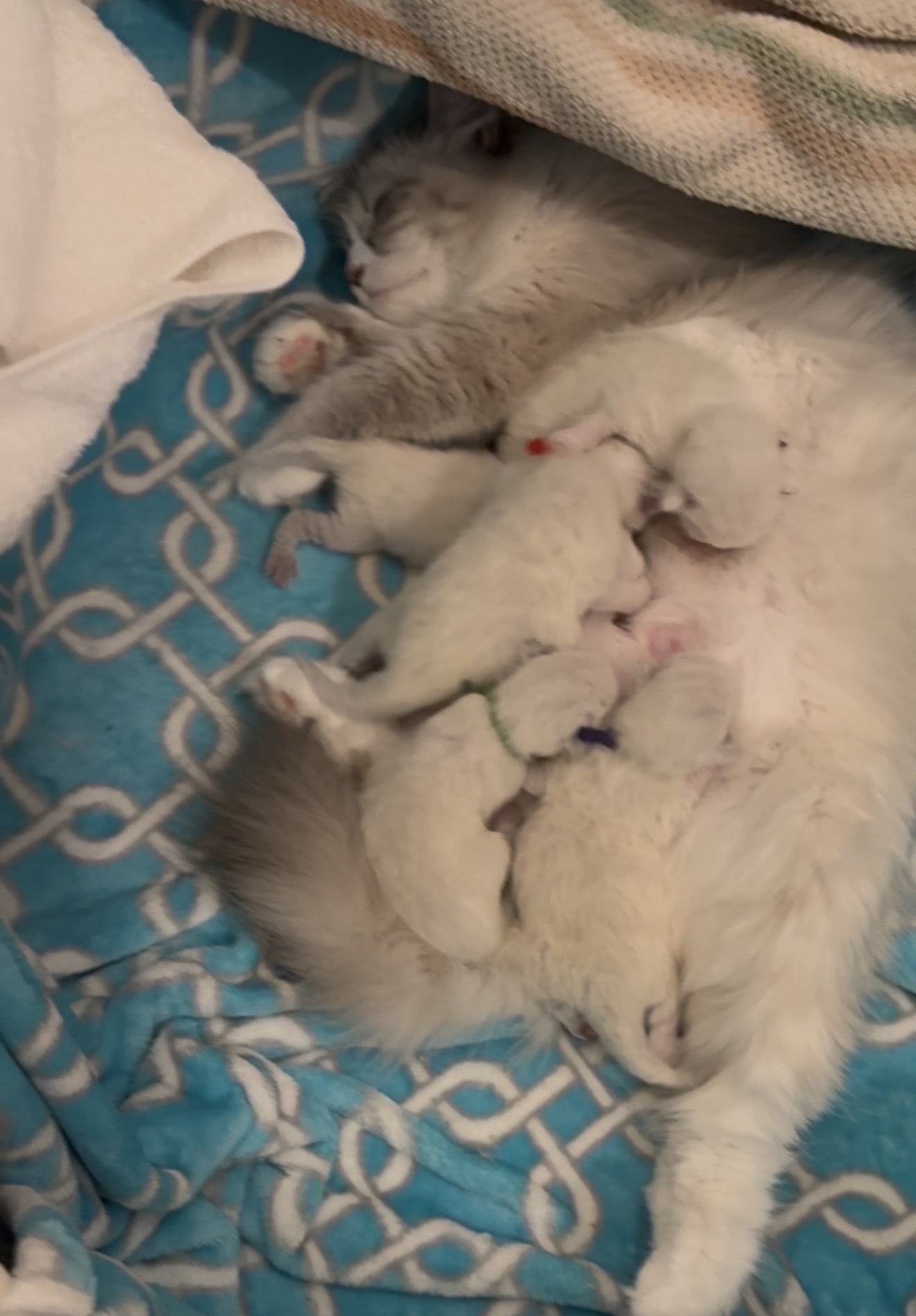
Newborns — born almost pure white
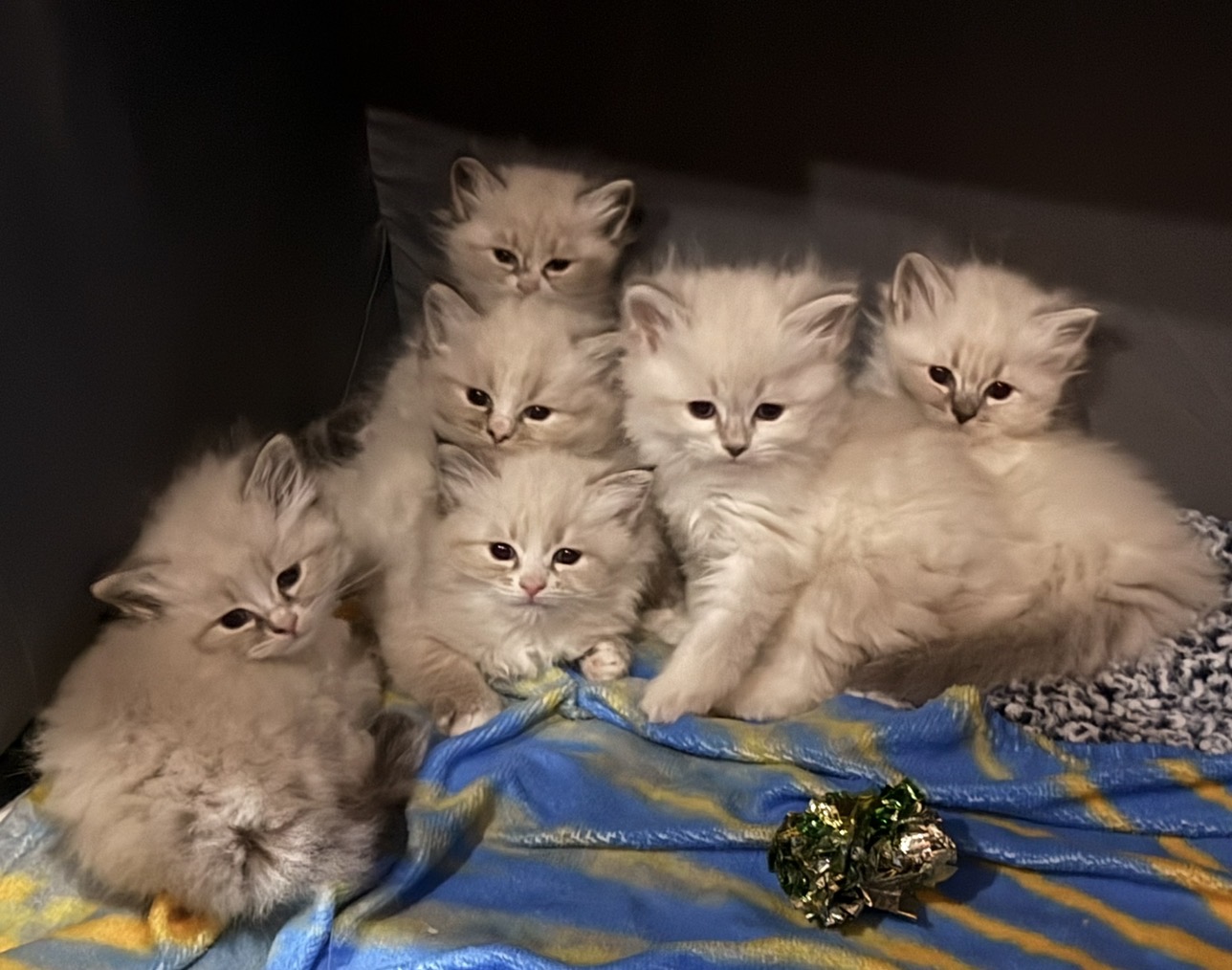
A few weeks older — points beginning to show
A seal point Neva may start almost white as a baby, develop tan coloring later, and eventually have a deep brown face, ears, and tail — while still keeping those unmistakable blue eyes.